By Ghith Al-Karmi
A personal reflection on ambition, money, family, and what professional success is actually supposed to give us.

Some days end with a strange feeling: I have been busy for hours, yet somehow I still haven’t done enough.
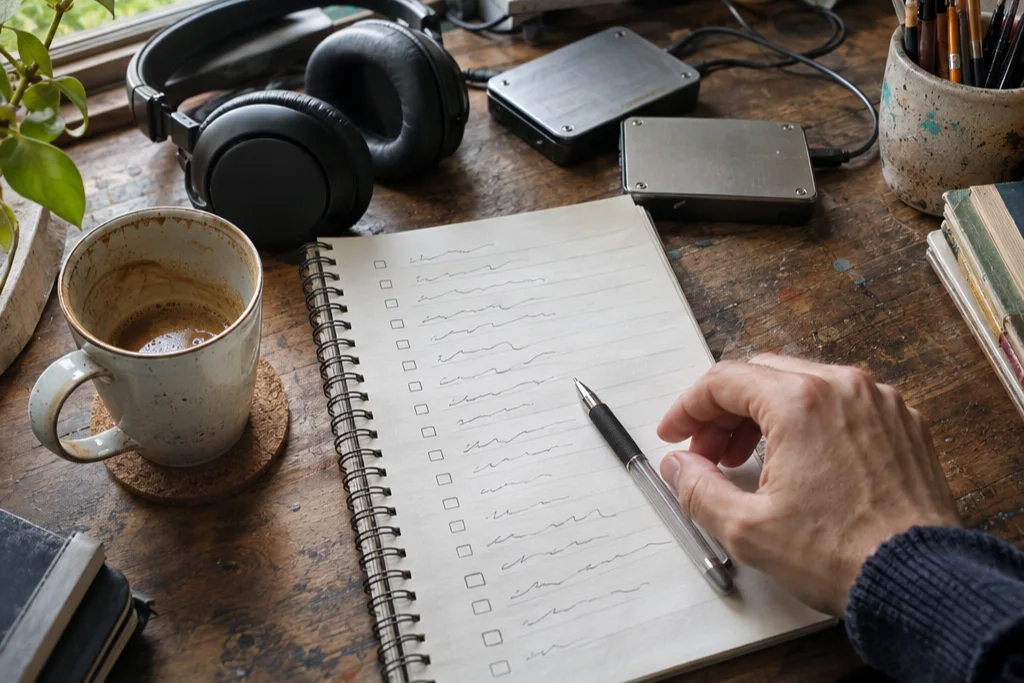
It isn’t necessarily because nothing got done. It’s because the list of things I should have done is longer than the list I managed to finish.
There is client work to deliver, a creative idea waiting to become real, and a personal project I want to see grow. There is also a family that deserves my attention, a body that needs rest, and a life I am supposedly working so hard to build.
The uncomfortable part is that whichever one I choose, I can usually find a reason to feel guilty about the others.
If I work, I might miss time with people I love. If I spend the evening with family, I may remember a financial obligation or a business opportunity I should have pursued. If I sit down to watch a film or work on a game simply because I enjoy it, I start calculating what those hours could have earned elsewhere.
That contradiction has left me with a question: Am I working to live the life I want, or have I slowly arranged my entire life around work?
When ambition turns into an endless checklist
I genuinely love working. I love taking an idea that exists only in my head and turning it into a scene, an image, a finished piece of filmmaking, or even a functioning game. Few things match the satisfaction of seeing the result and thinking: yes, that is what I was trying to make.
So I don’t subscribe to the idea that work is the enemy of a good life. Work can offer meaning, independence, pride, and the chance to build something worthwhile.
But there is a subtle point at which ambition changes its meaning. “I want to make something excellent” becomes “Every hour should produce something useful.”
And once that happens, an ordinary day starts feeling like a permanent performance review.
We get remarkably good at counting projects, deadlines, invoices, messages, and metrics. We become less skilled at asking what all that effort has actually made possible. Have we bought ourselves more freedom? Or just more obligations?
Money is not a footnote
It is easy to write about work-life balance from a comfortable distance. Just work less. Be present. Protect your evenings. Make time for what matters.
Those ideas sound sensible, but they are incomplete when rent, household expenses, unstable contracts, and family responsibilities influence every decision.
Not everyone putting in long hours is chasing status. Some people need the income. Some don’t know when the next client will arrive. Some are responsible for other people and cannot simply close a laptop and forget about tomorrow.
I don’t want “choose your happiness” to become another piece of advice that ignores financial reality. Freedom needs some measure of security, and financial security takes actual work to build.
Still, that creates another difficult question. If every free hour has to be spent defending the present, when do we get to build a different future?
Maybe the immediate answer isn’t to cut our working hours. Maybe it is to become more deliberate about what we are working toward, what price we are willing to pay for it, and which costs are simply too high.
The guilt of doing something for yourself
Sometimes the problem isn’t that we have no time. It’s that we no longer feel entitled to use time for anything that cannot be justified.
You start a movie and think about unfinished work. You open a personal creative project and calculate what two hours of paid work might have earned. You sit with your children and glance at the clock as though time itself is a competitor.
That doesn’t mean we don’t love our work or our families. It may mean we’ve begun applying a single productivity test to every part of life: What measurable outcome did this produce today?
But how do you measure a conversation with your child? What is the monetary value of an evening that becomes a family memory? How do you score the two hours someone spends learning to build a game before anyone knows whether that game will be worth selling?
Not everything meaningful needs to become a transaction, a deliverable, or a number on a dashboard.

Does freedom simply mean working from anywhere?
For a long time, my picture of professional freedom was geographical: the ability to travel, to open my laptop in a different city, and to avoid being tied to a single office or filming location.
I still want that possibility. But I’ve come to think that location independence and freedom are not the same thing.
You can take your laptop to a beautiful beach and spend the entire day answering clients, worrying about revisions, and chasing deadlines. The view changes. Your relationship with work doesn’t.
What I really want is not the right to work everywhere. It’s the ability to choose when I work, what I work on, and when I can stop.
For me, earning more would mean less if it required abandoning the filmmaking and game projects I care about, or being absent from family moments that won’t happen twice.
That doesn’t make money unimportant. It makes money a tool for building a meaningful life rather than the only available definition of one.
The cost of work is not purely emotional
There is a broader reality behind this personal question. The World Health Organization and International Labour Organization estimated that exposure to long working hours—55 hours a week or more—contributed to a substantial global burden of ischemic heart disease and stroke in 2016. These population-level estimates do not predict what will happen to any individual worker, but they do show why prolonged overwork deserves serious attention [1].
The OECD also frames work-life balance as more than the length of the working day. It includes the ability to combine paid work, family commitments, care responsibilities, leisure, and personal time [2].
Statistics cannot define a good life on our behalf. But they remind us that time has limits. Hours spent on one part of life are, inevitably, hours unavailable to another.

Loving your work isn’t the problem. Losing the choice might be.
Some people genuinely enjoy long, intense working days. Others want a predictable job that ends at a predictable hour. I don’t believe one arrangement is automatically right for everyone.
I don’t want a life without difficulty, either. I want demanding creative projects. I want to learn new tools, fail at experiments, and improve the next attempt. I want to build films and games that feel like my own.
What I don’t want is for every challenge to become a race that I never consciously agreed to enter.
There will be seasons when we need to work harder—because our responsibilities are real, or because an opportunity deserves a focused effort. But a demanding season shouldn’t silently become the permanent definition of our lives.
And the biggest change I want to make is in how I think about “unproductive” hours.
An afternoon with family is not a failed business decision. An evening spent experimenting with a game isn’t automatically wasted because it didn’t generate income. Rest doesn’t have to prove its return on investment before it earns a place on the calendar.
A different definition of success
Years ago, if someone had asked me what success looked like, I might have answered with bigger clients, more projects, and better results. Those things still matter to me, and I still take pride in doing good work.
But my definition is becoming wider.
It looks like earning enough to meet my responsibilities with dignity. Making creative work I can stand behind. Having time with my family without treating it as an interruption. Keeping a space for filmmaking, storytelling, and games even when the next experiment doesn’t immediately pay for itself.
I’m not writing this as someone who has already figured out the formula. Quite the opposite. I’m writing because I am still trying to understand it.
I’d like to reach a point where the question at the end of the day isn’t “How many hours did I work?” but “Did the work I did move me closer to the life I actually want?”

I don’t think we have to choose between ambition and living. Perhaps we just need to remember that ambition was supposed to open doors to life—not close them, one by one.
Are we working to live, or are we endlessly postponing life until the work is finished?
References
- World Health Organization & International Labour Organization, Long working hours increasing deaths from heart disease and stroke (2021; estimates for 2016).
- OECD, How’s Life? 2020 — Work-Life Balance.
This is an opinion essay. Reflective examples are illustrative rather than a verbatim record of specific events; it does not offer individual financial or medical advice.